SAMOSIR, NORTH SUMATRA (30 August 2013) - With governments, loggers, miners and palm oil producers poaching their lands with impunity, indigenous leaders from 17 countries gathered on a remote island in Sumatra this week to launch a global fight for their rights that will take advantage of powerful participatory mapping tools combined with indigenous knowledge to mark traditional boundaries.
“It’s amazing to see indigenous groups from all over the world coming here armed with hundreds of detailed maps they have created with things like handheld GPS devices and Internet mapping apps,” said Vicky Tauli-Corpuz, head of the Philippines-based Tebtebba, one of the co-organizers of the
Global Conference on Community Participatory Mapping on Indigenous Peoples’ Territories, which took place on the edge of the largest volcanic lake in the world. “It’s a new and vivid way to illustrate how they and their ancestors have inhabited and worked these lands for thousands of years and have every right to assert their ownership.”
Indigenous groups from countries including Malaysia, Nepal, Panama, Mexico and Brazil, explained how they have adopted affordable, high-tech mapping technology to retrace the history of their land ownership and catalog their natural resources. Their hope is that detailed maps can help them fight the destruction of vast tracks of forests, peatlands and waterways—brazen incursions by government and industry that not only deprive indigenous peoples of their lands but also greatly accelerate the global loss of biodiversity and accumulation of greenhouse gases in the atmosphere.
For example, participants at the conference believe maps of this sort could help bolster the fight in Indonesia to stop the steady loss of traditional lands to palm oil production, logging and other industrial needs. Participants issued a declaration calling on the government of Indonesia to pass legislation, currently under consideration by the nation’s Parliament, which would provide new protections for the country’s 50 million indigenous peoples.
“We need to take advantage of new mapping tools to accelerate the process of mapping the more than 30 million hectares we have left to document—before they are swallowed up by plantations,” said Abdon Nababan, secretary general of Indonesia’s Indigenous Peoples Alliance of the Archipelago (
AMAN), which has helped communities across the country to map their customary forests as part of their efforts to defend their lands against development by palm oil and other industrial plantations and mining.
A recent report stated that the Indonesian government’s continued practice of granting national and international companies permission to convert millions of hectares of forests to palm oil and other plantations on lands that overlap with or abut indigenous territories often leads to the displacement of indigenous peoples—and a rash of sometimes-violent land disputes. The
report on the state of large-scale agribusiness expansion in Southeast Asia by the Forest Peoples Programme (
FPP), also noted that the country faced more than 280 land conflicts across the country in 2012.
“Lines on a map have always been a source of conflict, but they are becoming more and more contentious around the world today,” said Tauli-Corpuz. “In many cases, government and military maps don’t acknowledge the presence of indigenous territories, leaving these communities vulnerable to land rights violations and conflicts, as well as the loss of their sustainable livelihoods, the onset of poverty, environmental degradation, and the loss of cultural heritage. Indigenous peoples are creating maps to protect their customary lands.”
Sleek computer-generated Indonesian maps presented at the conference documented cases in which the government had handed over indigenous territories to developers. In the case of the Lusan community in Borneo, three different government agencies had handed a community’s land over to three different companies—a logging group, a mining operation and a palm oil plantation.
“Without maps, it is difficult for indigenous peoples to prove that they have occupied their ancestral lands for centuries,” said Giacomo Rambaldi, a senior program coordinator at the Technical Centre for Agricultural and Rural Cooperation (
CTA), who has helped indigenous peoples to develop maps for more than 15 years. “If you are able to document and map your use of the resources since time immemorial, you have a chance of asserting your rights over land and water.”
It Takes a Village
Unlike satellite images or traditional political maps, the maps presented at the conference document key cultural and social sites, such as burial grounds, caches of medicinal plants, hunting trails or groves of specific species of trees. Based on pre-existing maps, satellite images or coordinates generated by hand-held GPS devices, these computer-generated documents or models record knowledge passed down through generations and integrate input from the entire community—including women and youth.
Conference participants heard that indigenous communities have successfully used these maps to protect their lands from land grabs and to monitor the impact of external forces on their lands.
In Brazil, South America’s largest democracy, an Afro-Brazilian community used a map to stop Cyclone-4, a space company jointly owned by Brazil and Ukraine, from expanding into their lands to build rocket launchers. These maps refuted claims by the company that only 10 communities would be impacted by the development by showing that more than 100 communities would be displaced. Cyclone-4’s expansion was blocked—though the government continues its efforts to build the rocket launchers on indigenous territories.
In Panama, which loses one percent of its tropical forests each year, members of the Guna community created a map—in the Guna language—to determine if the expansion of croplands had damaged sacred sites located in the rainforest surrounding their community. The map also served to show younger generations where these sites are located.
In Indonesia, the village of Pandumaan produced hand-drawn maps to scale, based on GPS data, to show that a pulp and paper company encroaching on their lands had razed the forests they rely on for myrrh—a fragrant resin that they sell for a living and use in spiritual rituals.
In Malaysia, which, along with Indonesia, is a leader in palm oil production, communities have used maps to win 25 of the 250 land disputes brought in front of the courts since 2001. The government continues to appeal the 25 cases that it lost in an attempt to regain the lands from indigenous peoples.
40 Million Hectares by 2020
Indonesia’s 2,200 indigenous communities, spread out across the country’s 18,307 islands, are the most prolific indigenous map-makers, the conference revealed. These mapping efforts have added urgency, since the country’s Constitutional Court decided in May that a line in the country’s 1999 Forestry Law, which states that customary forests are state forests, is not constitutional. To take advantage of this decision, which would first have to be implemented in national and local law, experts from the conference said it’s crucial for indigenous peoples to put these forests on paper.
AMAN’s Abdon Nababan said that he hopes to help map all 40 million hectares of land by 2020, and he called on the national Parliament to speed up the adoption of the Law on the Recognition and Protection of the Rights of Indigenous Peoples. The body is currently reviewing a draft of the law.
“Without Indigenous Peoples, There Would Be No Forests”
“Mapping not only empowers indigenous communities with evidence that they can use to assert their land rights, it also provides communities with the ability to catalog the natural resources sheltered in their territories,” said Tauli-Corpuz, the head of Tebtebba. “These maps successfully demonstrate what we already know: that indigenous peoples are the best custodians of their forests and lands.”
A study by The International Union for Conservation of Nature (IUCN) finds that biodiversity thrives in indigenous territories where communities are free to engage in hunting and other sustainable uses of natural resources—as opposed to state-held protected areas that ban such activities.
The National Coalition of Indigenous Peoples (
KASAPI) in the Philippines arrived at the same conclusion. The project, which inventoried the resources in indigenous communities across the country, concluded from evidence gathered on the ground and from village elders—who recalled which species of plants have disappeared since their youth—that forests and lands owned and managed by indigenous peoples have stronger biodiversity than those that are under government control.
According to conference participants, maps that document a territory’s biodiversity provide indigenous communities and national governments alike with “baseline” knowledge about the health of their natural resources, enabling them to monitor changes to natural resources, such as the restoration—or degradation—of forests over time. Participants added that maps like these can show the impacts of climate change—and aid in the tracking of global efforts to reduce greenhouse gas emissions.
Vu Thi Hien of the Centre of Research and Development in Upland Areas (
CERDA), taught members of the Thai Nguyen community in Vietnam how to map in order to support an international climate change effort to reduce climate change through the protection and preservation of forests, known as REDD+. She said that local authorities were so impressed with the professionalism and accuracy of the maps that they adopted the maps for their own use.
“If the community is not empowered to assert their rights, they can only go so far, even with strong laws supporting land rights,” Tauli-Corpuz said.
###
About Tebtebba
Tebtebba (Indigenous Peoples’ International Centre for Policy Research and Education) is an indigenous peoples’ organization born out of the need for heightened advocacy to have the rights of indigenous peoples respected, protected and fulfilled worldwide. It also advocates and works on the elaboration and operationalization of indigenous peoples’ sustainable, self-determined development.
www.tebtebba.org.
About AMAN
AMAN’s mission is to pursue sovereignty, prosperity and dignity of indigenous peoples. Established on 17 March 1999, its members consist of 2,240 indigenous communities in Indonesia.
www.aman.or.id.

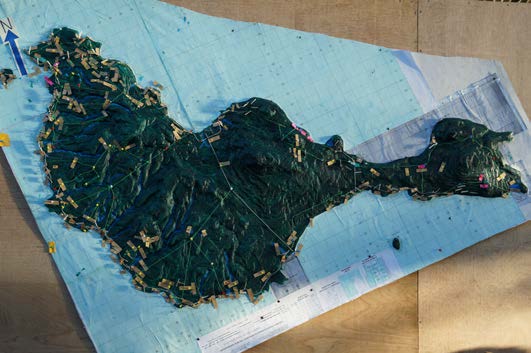 Land boundary is a critical challenge in Vanuatu. On Epi alone, such project implementation requires acquisition of land prior to any physical work being carried out. The use of Participatory 3-D modeling gave land owners and area council representative a physical overview of the roading issues. After recognizing the problems and the proposed solutions under the PACC Vanuatu project, the land owners and area council representatives agreed to give ' for free' their land and resources for PACC project implementation on Epi. Under the PACC project where the thematic area is Coastal Infrastructure, the road relocation project is aimed at building resilience and improving access for the people to the main service and commercial center on the island.


